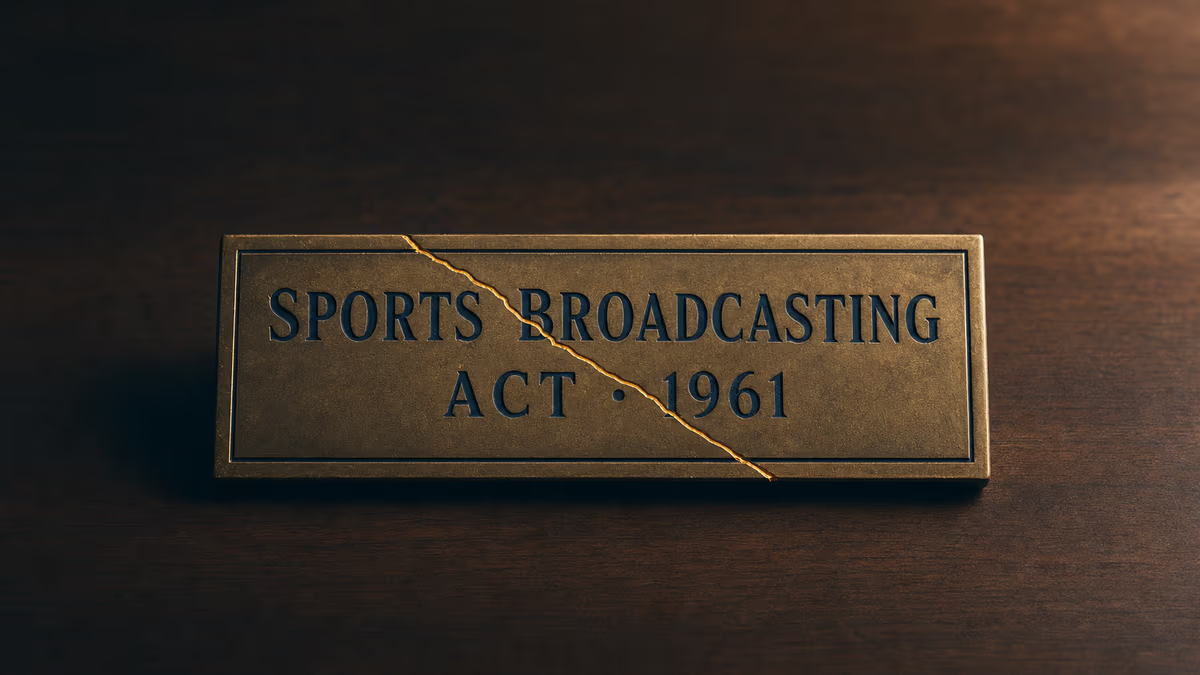
The 1961 Sports Broadcasting Act was written for a world with three networks, no cable, and a single delivery technology Congress could name in two words: “sponsored telecasting.” Sixty-five years later, three federal pressure tracks have lined up against that two-word phrase in roughly 60 days.
The FCC Media Bureau opened MB Docket No. 26-45 in late February to interrogate sports-rights migration. FCC Chairman Brendan Carr said publicly a month later that the NFL’s antitrust shield could “collapse” once enough games sit behind paywalls. Fox Corporation (NASDAQ: FOXA) and Sinclair, Inc. (NASDAQ: SBGI), the two broadcasters most exposed to the broadcast-to-streaming migration, filed FCC comments arguing the statute simply does not cover streaming. And on April 9, as The Wall Street Journal first reported, the Department of Justice’s Antitrust Division opened a formal investigation into the NFL’s media-rights structure.
None of these tracks alone rewrites the law. Together they build a record. And the record now points one direction the upfront market hasn’t priced.
A 1961 statute meeting a 2026 carriage model
The Sports Broadcasting Act, codified at 15 U.S.C. § 1291, gave the NFL, MLB, NBA, and NHL a narrow Sherman Act exemption to pool team rights into a single league-wide package, but only for “the sponsored telecasting of the games.” Cable was a curiosity. Subscription streaming did not exist. Courts have construed that two-word phrase narrowly ever since. The controlling appellate ruling, the Third Circuit’s 1999 Shaw v. Dallas Cowboys, held that the SBA “covers only free telecasting of professional sports games” and does not extend to subscription distribution. Shaw concerned DirecTV’s NFL Sunday Ticket. Streaming has never been litigated under the statute. The legal logic, though, is already there.
Two more rulings sit on top of Shaw. The Supreme Court’s unanimous 2010 decision in American Needle v. NFL rejected the league’s “single entity” defense, holding that NFL clubs’ joint conduct is concerted action by 32 separate economic actors and reviewable under Section 1 of the Sherman Act. Alston in 2021 reinforced that sports leagues do not get judicially crafted antitrust shields without explicit congressional action. The SBA is the one carve-out that survived that doctrinal drift, and its statutory hinge is the medium it covers.
What changed in 2026 is who started saying so out loud.
Three converging pressure tracks
Senator Mike Lee (R-Utah), the Senate Judiciary Antitrust Subcommittee chairman, wrote DOJ and the FTC on March 3 asking the agencies to probe whether NFL streaming pricing is consistent with the SBA. His framing was the consumer-cost frame: “To watch every NFL game during this past season, football fans spent almost $1,000 on cable and streaming subscriptions.” Lee added the legal hinge, citing the same reading Shaw embraced: “‘Sponsored telecasting’ refers to broadcasts financed through advertising and made available free to the public.”
The cost figure has more rigor behind it than political letters usually carry. Sportico’s named-methodology calculation put the all-in 2025 cost to watch every NFL game at $935: roughly $328 in regular-season streaming fees across ESPN, Fox One, Paramount+, Peacock, and Prime Video, plus $522 for YouTube Sunday Ticket with RedZone, plus playoff and Super Bowl access. Lee’s “almost $1,000” number is essentially Sportico’s number, rounded.
The FCC docket arrived three weeks earlier. DA 26-188 was the Media Bureau’s invitation to comment on how sports-rights migration affects consumers and local broadcasters. It explicitly named Disney/ESPN, Paramount+, Fox One, Peacock, Prime Video, YouTube, Netflix (NASDAQ: NFLX), Apple TV+, and TBS as services in scope. By the April 13 reply deadline, the docket had drawn more than 8,500 comments.
Carr’s late-March remarks at a Washington event did not announce policy. They previewed an argument:
You sort of tip the scale, and they’ve just put too many games behind a paywall, and then that whole exemption collapses.
Carr also asked, in the same remarks first reported by Semafor: “Does the NFL still benefit from the antitrust exemption when they’re negotiating for carriage of games not on a sponsored telecast, but on a streaming service? That’s a very live, very ripe question.” The FCC has no statutory authority to rewrite the SBA. It has a record-building authority that ends up cited by courts and Congress, the same posture it has run on three other streaming-touching dockets in the past six weeks (our prior coverage).
Then the broadcasters spoke. On the FCC’s March 27 comment deadline, Fox Corporation and Sinclair both filed comments arguing the SBA does not exempt streaming. Per Sportico’s reporting on the filings, Fox’s filing, signed by Joseph Di Scipio, said “the statute does not exempt negotiations that the leagues may have with streaming services” and urged the FCC to “take a closer look under the regulatory hood.” Sinclair’s filing, signed by David B. Gibber, was sharper: the exemption “effectively allows the NFL to operate as a cartel for media rights” and “applies exclusively to TV rights.” Sinclair invoked Shaw by name; Fox advanced the same statutory reading without citing the precedent.
That is structurally new. For 60 years the NFL and the broadcast networks have stood on the same side of antitrust questions, both benefiting from pooled rights. Fox’s 11-year extension through 2033 locked it into the broadcast camp; Sinclair, weakened by the Diamond Sports bankruptcy, has the strongest commercial motive among the broadcasters to push the broadcast-only reading. They broke the alignment, on the record, in a federal docket.
Twelve days later, DOJ disclosed its probe. The Wall Street Journal, which first reported the investigation on April 9, quoted a government official describing it as “about affordability and creating an even playing field for providers.” Same frame. Same week the Live Nation jury verdict landed on the same theory. Different agency, different statutory authority, same target.
What buyers haven’t priced
The NFL’s defense, set out in an April 17 ex parte filing following a meeting with senior staff to Carr, leans on a single number: “Our contracts with ABC, CBS, Fox and NBC account for the distribution of more than 87% of all NFL games.” The figure is true on a per-game basis. It also obscures where the league’s distribution model is actually headed.
The signal hidden in the 87 percent: primetime, holiday, and out-of-market inventory, the highest-CPM windows advertisers actually pay up for, is disproportionately streaming-only.
- Amazon’s Thursday Night Football package is exclusive at roughly $1 billion per year.
- Google’s Sunday Ticket out-of-market product is exclusive at roughly $2 billion per year.
- Netflix’s Christmas Day games are exclusive. The Wall Street Journal reported on March 30 (Toonkel and Flint) that Netflix is in talks to double its package from two annual games to four, adding a Thanksgiving Eve matchup and an international Week 1 game, against an existing fee The Journal pegged at roughly $75 million per game.
That last item is the migration pattern Carr’s “tipping point” remark was about. Per The Wall Street Journal’s reporting, the league is also building “mini-packages of four to five games” for renegotiations across the partner set. That is the mechanism by which more inventory ends up streaming-exclusive, package by package, without a single contract negotiation that announces itself as the tipping point.
The buy-side question this raises is the one the upfront isn’t asking: what is the regulatory tail-risk on a streaming-only NFL package committed to in 2026? A DOJ consent decree could impose carriage limits. A targeted SBA amendment in Congress, the cleanest legislative fix, could expressly exclude subscription distribution from the exemption, mirroring Shaw. Formal FCC findings in MB Docket 26-45 could shape the next renewal cycle. None of those outcomes are priced into current CPMs because none of them have happened yet. All three are now being built toward by separate institutional actors working off the same factual record.
This is the same dynamic we documented in baseball, where MLB’s six-platform 2026 framework is producing parallel consumer-cost arguments, and the same dynamic we covered in the ESPN/YouTube TV blackout, where carriage friction translated to a $110 million quarterly hit to Disney. Sports rights friction in the streaming era has stopped being a theoretical regulatory concern.
The 2029 cliff
Most current NFL contracts run through 2032–33, with opt-out windows in 2029. That is the first commercial moment any of this regulatory pressure could actually bind. The Ninth Circuit’s pending Sunday Ticket decision could land within months and run a parallel court track. DOJ could move from informal investigation to civil investigative demands. CBS, NBC, and Disney, conspicuously absent from the broadcaster-side filings so far, will eventually have to commit to a posture in MB Docket 26-45. Disney, with ESPN+ on the streaming side and ABC on the broadcast side, will be the most interesting answer.
The exemption was written when “telecasting” had one meaning. It is unlikely to survive the next renewal cycle with that meaning still intact.