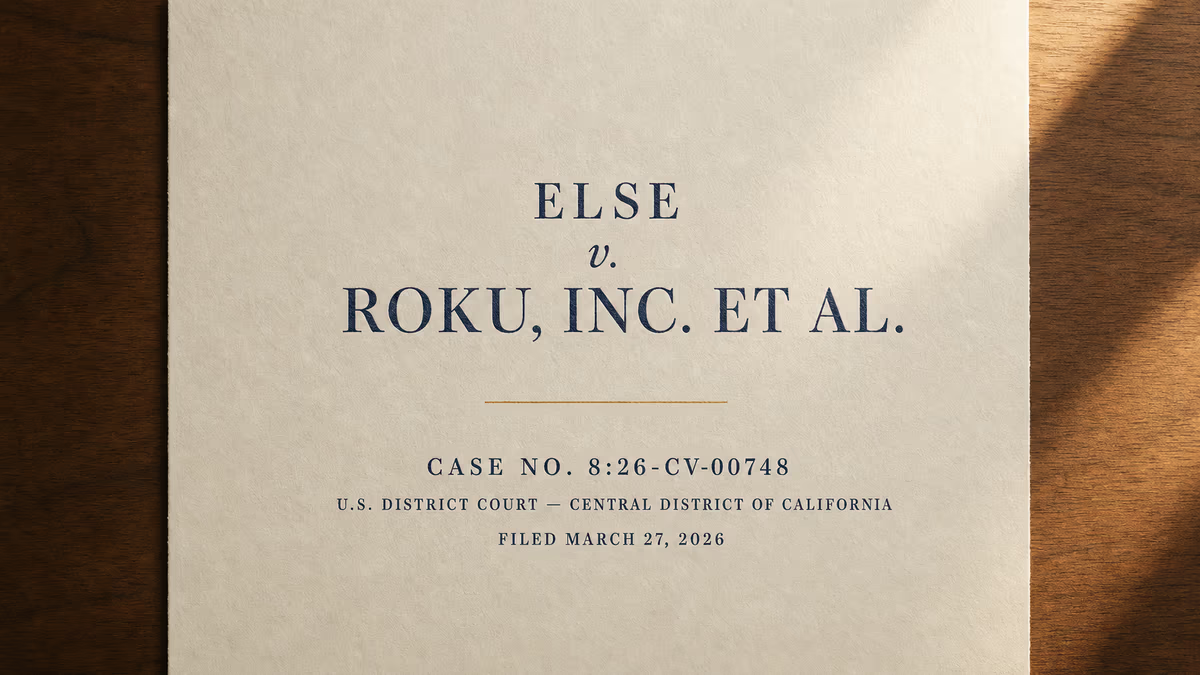
A federal complaint filed last month against Roku, Inc. and the US arm of TCL asks a question every smart-TV operating system has so far avoided having to answer in open court: when an automatic over-the-air software update bricks the device, who owes the consumer what? Else v. Roku, Inc., et al., Case No. 8:26-cv-00748, was filed March 27 in the Central District of California by Terri Else and her counsel at Schonbrun Seplow Harris Hoffman & Zeldes LLP. The proposed nationwide class plus California subclass covers buyers of Roku Select Series, Roku Plus Series, and TCL 3-, 4-, 5-, and 6-Series Roku TVs going back to December 16, 2024. The complaint alleges that Roku’s software updates are “repetitively defective, materially impairing the functionality of Roku products, rendering many consumers’ televisions either entirely unusable (‘bricked’), blacked out or otherwise substantially degraded.” The pleaded counts are breach of express and implied warranty, violations of California’s Unfair Competition Law and Consumers Legal Remedies Act, and violations of the Song-Beverly Consumer Warranty Act. Aggregated class damages are alleged to exceed $5 million, the CAFA threshold.
The case will most likely settle. Most consumer-products class actions do, and Roku’s first procedural move is likely to be a motion to compel arbitration citing the mandatory Terms-of-Service update the company pushed in March 2024, the one that disabled Roku devices until users agreed to a binding-arbitration and class-action-waiver clause. The interesting question is not whether Else v. Roku wins. The interesting question is what the discovery process surfaces about how a smart-TV OS provider designs, tests, and ships an update that runs on roughly 28 percent of US broadband households. That number is the at-risk surface, and it sits inside the same 100-million-household installed base Roku just told Wall Street is the foundation of a $613 million quarterly ad business at a 60.5 percent gross margin. The upside and the downside of OS-as-platform are arguments about the same asset.
Roku’s software updates are repetitively defective, materially impairing the functionality of Roku products, rendering many consumers’ televisions either entirely unusable (‘bricked’), blacked out or otherwise substantially degraded in terms of device performance.
What the licensed-OS contract actually says
The smart-TV-OS market is built on a click-through end-user license at first boot. The OEM ships the hardware, the OS provider pushes updates over-the-air, and the consumer agrees to those updates by tapping through the EULA the first time the TV connects to Wi-Fi. Roku and TCL wrote that contract together in 2014, when TCL became Roku’s first major OEM partner under the OS-licensing model Roku introduced at CES that year. Every smart-TV-OS-licensing contract since carries that same structure: Tizen on Samsung’s own hardware, webOS on LG’s, Google TV on Sony and Hisense and TCL’s flagship lines, SmartCast on Vizio (now a Walmart subsidiary), Fire TV on Amazon’s own hardware and on Hisense and other licensees. The OS provider ships updates. The consumer agreed at first boot. The contract has, until now, never been tested in a US federal class action that names the OTA update mechanism itself as the defect.
The complaint frames Roku’s marketing as compounding the warranty exposure. Per Top Class Actions’ reproduction, plaintiff alleges Roku marketed the affected TVs as devices that “keep getting better over time…thanks to [ongoing] automatic software updates,” language the complaint contends is inconsistent with a defect rate it characterizes as widespread enough to be repeatedly defective. Whether that characterization holds is a question for discovery. What it does in pleading form is reframe the OTA update from a vendor courtesy into a contractual representation, which is the move that lets warranty law reach into a software-stewardship question that has historically lived inside terms of service no one reads.
TCL’s posture in the case is more ambiguous than the headline suggests. The OEM has spent the last four years quietly migrating its flagship lineup off Roku-OS toward Google TV. TCL’s QM7K, QM8K, and QM9K series ship Google TV; the lower-priced 3-, 4-, 5-, and 6-Series remain Roku-OS. The complaint targets exactly the legacy SKU range TCL itself has been moving away from. So the at-risk-installed-base for TCL specifically is concentrated in the value end of the lineup, in households that bought a co-brand the manufacturer is already exiting. That dynamic gives TCL a structural incentive to push the stewardship question back onto Roku’s update infrastructure, where the alleged defect originates, and Roku a structural incentive to argue the OEM owns the warranty surface, because the OEM is the seller of record on every consumer purchase.
The 28-percent question
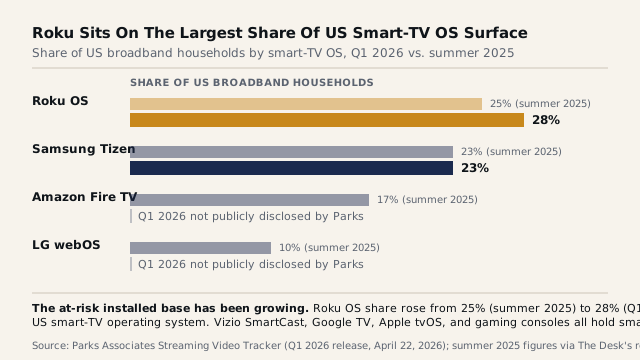
Pull back to the OS-share map and the case’s industry-wide exposure becomes legible. Per Parks Associates’ Q1 2026 Streaming Video Tracker, Roku OS runs on 28 percent of US broadband households, ahead of Samsung’s Tizen at 23 percent. Parks does not publicly disclose the rest of the breakdown in the press release, but its prior summer 2025 research, referenced by The Desk, put Amazon Fire TV at 17 percent and LG webOS at 10 percent. Roku’s own share has grown over the alleged class period, from 25 percent in summer 2025 to 28 percent today. The at-risk installed base under any adverse OS-stewardship ruling has been expanding, not shrinking. That is the structural reason this case matters past Else and Roku.
Parks Associates’ Michael Goodman, Director of Entertainment, framed the broader stake of OS control in the release: “Control of the platform layer is central to competition in the connected TV market. Operating systems determine what content consumers see, how services are positioned and how advertising is delivered.” Goodman’s frame is competitive; the Else complaint is its mirror. The same OS-layer ownership that makes the platform monetizable is the OS-layer ownership that, plaintiff alleges, lets a vendor ship a bricking update at scale without recourse.
The other licensed-OS providers are watching for two specific reasons. The first is precedent. A California federal court ruling on whether an OTA-update EULA can immunize a vendor against express-warranty breach when the update bricks the device would resonate immediately to Tizen, webOS, Google TV, SmartCast, and Fire TV. Every one of those ships updates under contract structures broadly similar to Roku’s. The second is allocation. The Else complaint names the OEM (TCL) and the OS provider (Roku) as co-defendants, but the alleged defect mechanism originates in the OS update layer. How the case allocates liability between OEM and OS-provider, assuming it gets past arbitration, would set the playbook for every future licensed-OS contract negotiation. Samsung and LG, which run their own hardware and their own OSes, would absorb both sides of any allocation question internally; Hisense and Sharp and Element and the other OEM licensees would not.
Two bills coming due on the same asset
Roku’s first quarter under split Advertising and Subscriptions reporting put a $613 million ad line at 60.5 percent gross margin against the same 100-million-household installed base the Else complaint frames as the at-risk surface. The two stories are about the same asset, told from opposite directions. The Q1 print is the upside argument for OS-as-platform: if you own the OS layer, you can monetize it at margins no other CTV layer reaches. Else v. Roku is the downside argument: if you own the OS layer, you also own the duty of care that runs with the contract that lets you push updates to it.
The Q1 print made no mention of the case. Roku’s 10-Q for the quarter has not yet been filed; the legal-proceedings disclosure section, when it appears, will be the first material data point on how Roku internally classifies the exposure. Whether the case is characterized as a material legal proceeding, downplayed as ordinary-course consumer litigation, or omitted entirely will tell investors more about Roku’s read of the case’s reach than any defense filing in the docket itself.
Three procedural moments and a question of contract
Roku’s likely motion to compel arbitration under the March 2024 TOS update comes first; how the court rules on the unconscionability of an arbitration clause pushed via mandatory device-disabling notice, applied against bricking-defect class claims, is the gating question for whether discovery happens at all. Roku’s Q1 2026 10-Q legal-proceedings disclosure comes next — the first regulatory window into how Roku itself sizes the exposure. The third is whether plaintiff’s counsel files parallel actions in other jurisdictions, or amends to add Hisense, Sharp, Walmart’s onn brand, or other Roku-OS OEM licensees as co-defendants. Each new defendant adds installed-base surface, and each parallel action raises the systemic-precedent stakes.
The complaint’s outcome may settle or it may not. The legal-mechanism question, whether a click-through EULA at first boot can survive an over-the-air update that bricks the device, is the one that propagates regardless. Every other smart-TV OS in the US ships under a contract built on the same structure Roku and TCL wrote together in 2014. This is the first case that asks a federal court whether that structure holds.