The first carriage dispute Disney has fought as the owner of NFL Network landed exactly the way most analysts expected the strategy to land. Comcast turned off the channels.
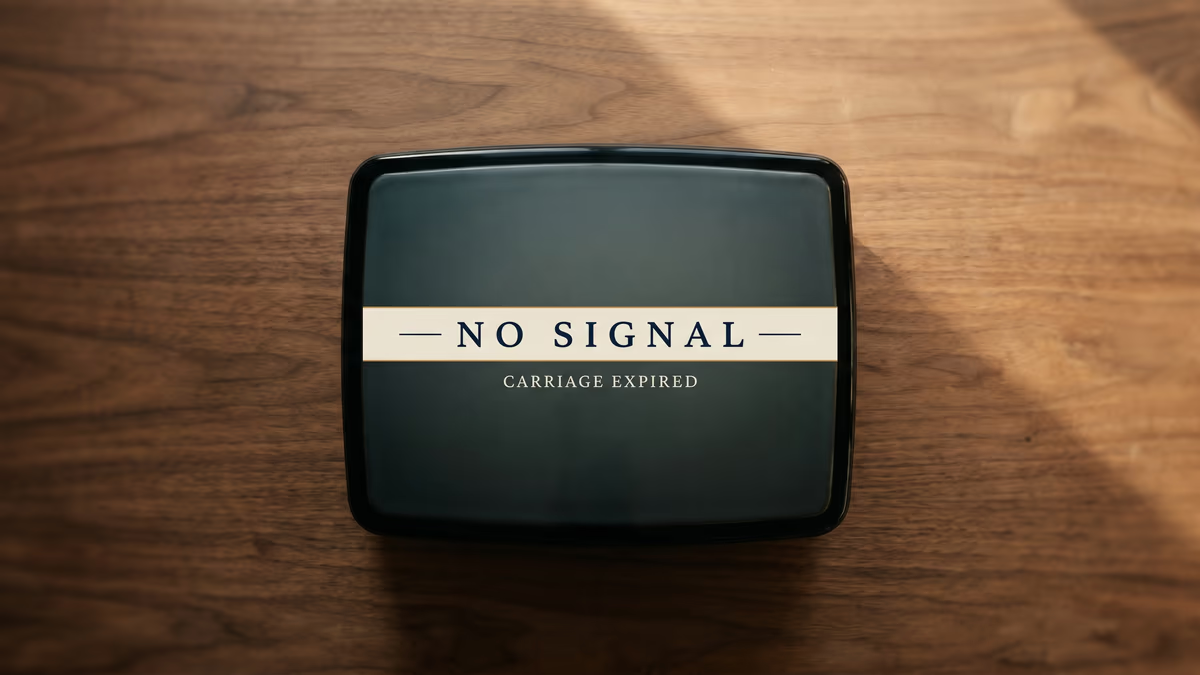
NFL Network and NFL RedZone went dark on Xfinity TV and Xfinity Stream on May 1, 2026, after the carriage contract expired without a new deal in place. Comcast and Disney/ESPN each issued statements through their corporate press teams, each blaming the other for the breakdown. Comcast’s spokesperson said the company’s contract had expired and the parties were “in discussions with the new owner, Disney/ESPN, about our future carriage of the network.” Within hours, the company sharpened the framing: “Disney and ESPN acquired NFL Network and Red Zone just months ago and are already demanding double the fees for the same content.” Disney/ESPN’s response carried the now-familiar shape of a Disney carriage standoff — “good-faith proposals,” “fully committed to reaching a fair agreement” — without disclosing what it had asked for.
The fees question is the surface dispute. The structural one is what the 10% NFL equity stake in ESPN, the consideration ESPN paid for the deal that closed February 2, 2026, does to every NFL Network carriage negotiation that follows. Disney’s SEC filing the Monday after closing put the fair value of that stake at approximately $3 billion, against an implied $30 billion enterprise valuation for ESPN. Post-close ESPN equity sits 72% Disney, 18% Hearst, 10% NFL. The Comcast standoff is the first time that ownership architecture has been pressure-tested against a distributor.
Why this dispute is structurally different from the eight before it
NFL Network has been in carriage fights with major MSOs for two decades. The 2009 Comcast dispute, settled with a 10-year deal that placed the channel on Digital Classic at a reported 40–45 cents per subscriber (down from the league’s 70-cent ask), was the template. The May 2023 brief blackout on Xfinity, resolved within roughly 24 hours after Commissioner Roger Goodell intervened personally, was the recent precedent.
Both prior fights had a third-party arbiter. The league owned the channel; the league wanted broad distribution; Goodell could pick up the phone. That is the player who is gone.
With the equity stake, the NFL is now financially aligned with whatever rate Disney/ESPN extracts. Every dollar of incremental carriage fee Disney negotiates flows partially back to the league, not in sales-and-licensing form, but as accretion to a $3 billion equity position. The commissioner who personally got the channel switched back on within 24 hours in 2023 is now on the seller side of the bargaining table. The league itself, which once acted as the channel’s chief advocate for distribution, has not commented publicly on the Comcast standoff at all — a silence that, given the equity stake, is itself a data point about how the new ownership structure is being navigated. There is no longer an outside party who wants the dispute resolved fast more than Disney/ESPN does.
The 2025 Disney playbook: This is also not Disney’s first carriage blackout in seven months. The 15-day YouTube TV outage in late 2025, which Disney’s Q1 FY2026 earnings release booked at approximately $110 million in lost ESPN segment operating income (and which produced the ESPN layoff round we covered in April), established the company’s posture: refuse the distributor’s rate, take the carriage off, accept the near-term subscriber-rage and ad-revenue hit, force the higher rate. That blackout settled with Google committing to add ESPN Unlimited to YouTube TV’s base plan at no additional cost by fall 2026. The standoff with Comcast follows the identical Disney spokesperson script and the identical underlying calculation.
The two material differences: the NFL Network blackout is currently lower-stakes for Disney than the YouTube TV blackout was. RedZone does not broadcast in the summer, NFL Network’s preseason game schedule does not begin until August, and Disney/ESPN therefore has runway to hold out without consumer-facing escalation. The political backdrop, on the other hand, is meaningfully harder. The DOJ Antitrust Division opened an investigation into the NFL’s media-rights structure in April; the FCC’s MB Docket 26-45 on sports broadcasting practices has drawn more than 8,500 comments; FCC Chairman Brendan Carr has floated the question of whether the 1961 Sports Broadcasting Act’s antitrust shield survives once carriage moves to subscription distribution. As our coverage of the Fox-Sinclair filings on the same docket documented, the regulatory record is being built right now. Every blackout headline lands in that record as evidence of the same problem the docket is investigating.
The shrinking base every dollar has to clear
The financial logic of the dispute exists on a steeply declining household base. NFL Network’s reach was approximately 71.1 million U.S. households at its 2015 peak and approximately 44 million by the time of the August 2025 ESPN deal announcement, roughly a 38% decline over a decade as cord-cutting compounded. Comcast itself reported 322,000 video subscriber losses in Q1 2026, a slowing of churn but still material attrition.
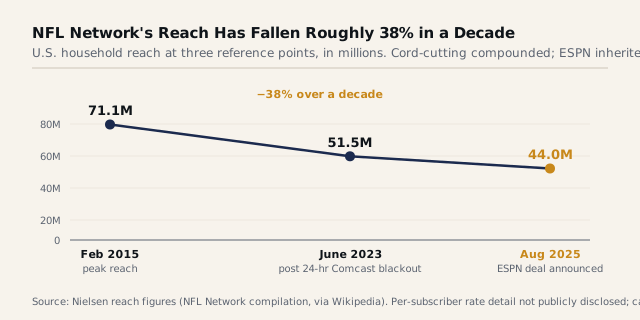
Disney’s ask, whatever its actual size, has to clear that math. A “double the fees” demand against a 10-year contract signed in a 71-million-household world reads differently when the household base is heading toward 40 million. Every basis point of rate negotiation has to compensate for the eroding base, which is why the negotiation is happening at all, and why both sides have priced the standoff cost into their willingness to sustain it.
For Comcast, the math also runs the other way. Xfinity Video subscribers churn faster when their bill includes channels they cannot watch. The Biddle v. Disney class-action settlement preliminarily approved in April 2026 (the case that established Disney must consider proposals from streaming live pay-TV providers for packages with fewer Disney networks, potentially excluding ESPN) is a marker of the ceiling on how far Disney can push the bundling-power lever before judicial constraints meet it.
Disney and ESPN acquired NFL Network and Red Zone just months ago and are already demanding double the fees for the same content.
The pull-quote framing matters because it telegraphs the only public number in the dispute. Comcast has put a multiplier on Disney’s ask; Disney has not contested it. In carriage negotiations, the absence of a counter-claim is itself the data point.
The upfront problem nobody has priced
May is the wrong month for an NFL distribution blackout to be the headline. Buyers are weeks away from committing to NFL inventory across NFL Network, ESPN Unlimited, Amazon’s Thursday Night Football, Netflix’s Christmas Day games, and YouTube TV. The pricing logic of those commitments assumes a distribution architecture that is not in active dispute with the third-largest pay-TV operator in the country. It assumes carriage rate increases of the magnitude Disney is reportedly seeking are absorbable by MSOs, not blackout-triggers. And it assumes the regulatory environment around NFL distribution remains in inquiry-and-comment phase rather than active enforcement.
A short blackout that resolves in weeks confirms the standard framing. A blackout that extends through preseason, or that spreads to other Disney/ESPN distributor relationships, or that draws explicit regulatory attention, would force the kind of repricing of NFL streaming inventory that no buyer has built into May 2026 budgets. Watch Disney’s Q3 FY2026 earnings call in early August for the first quarterly disclosure that could materialize the cost of the strategy. Watch the next FCC comment cycle in MB Docket 26-45 for whether the dispute enters the formal regulatory record. Watch whether ESPN escalates to threatening to pull ESPN itself from Comcast’s lineup. The moment that lever is named publicly, the political math changes.
The 2025 YouTube TV blackout cost Disney $110 million and produced a settlement on Disney’s terms. The 2026 Comcast blackout starts with the same playbook running, the same scriptwriter, and a co-owner of the channel sitting next to the seller. What it does not start with is the third-party arbiter who, twice before, picked up the phone and got the channel turned back on.