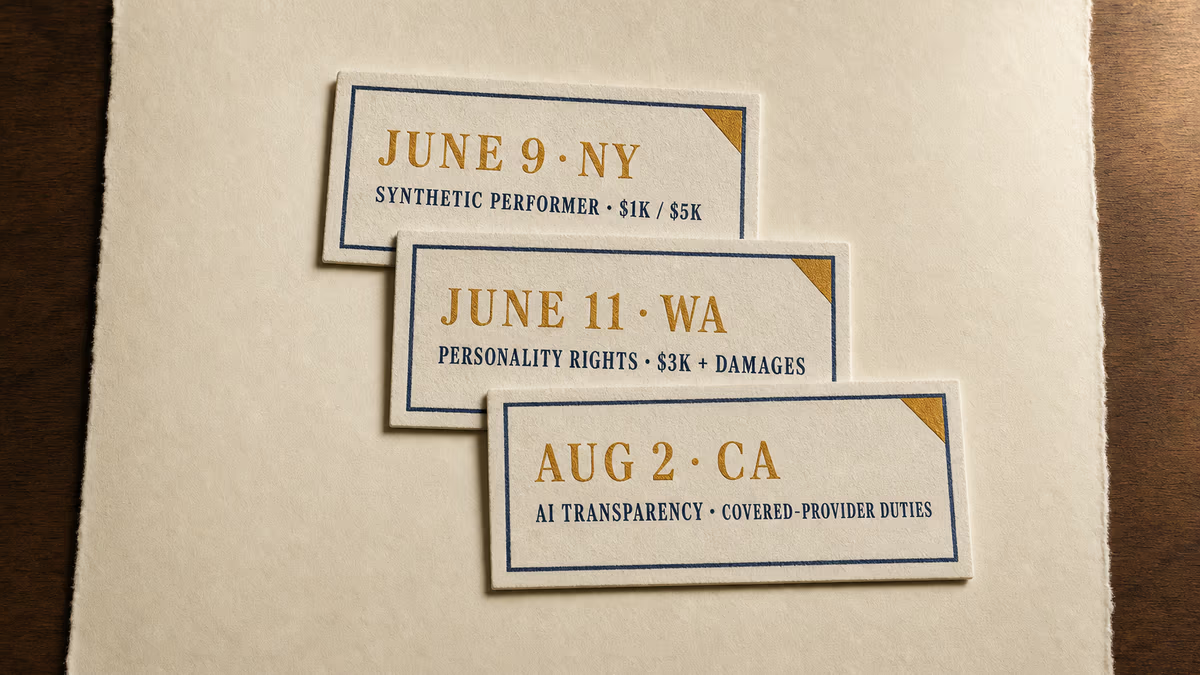
By June 9, every CTV advertiser running national creative has to know whether the spots in its trafficking queue contain a “synthetic performer.” New York’s General Business Law §396-b, signed by Gov. Kathy Hochul in December, says so. A first violation costs $1,000. Every one after that costs $5,000. Two days later, Washington’s SB 5886 folds “forged digital likeness” into the state’s Personality Rights Act, doubles the civil penalty to $3,000, and adds noneconomic damages to the recovery menu. Fifty-four days after that, on August 2, California’s revised AI Transparency Act becomes operative at $5,000 per violation, per day. The EU AI Act’s Article 50 deepfake-disclosure obligation goes live across Europe on the same August 2 date.
That is the compliance window national CTV ad-buying organizations are now five weeks from. Most have not yet built the protocol that answers it.
A 54-day compliance window most buyers haven’t seen yet
The patchwork itself is not new. The stack-up is. Tennessee’s ELVIS Act, signed by Gov. Bill Lee in March 2024, was the first state law to extend right-of-publicity protection to AI voice clones; it took effect that July. Ballotpedia counted 15 more deepfake bills enacted across the states in the first quarter of 2026 alone, every one of them additional coverage in a state that already had something on the books. Forty-seven states have a deepfake statute; only Alaska, Missouri, and Ohio remain holdouts. California alone has enacted 21 since 2019.
What changes this quarter is that the enforceable mass crosses a threshold for ad buyers specifically. Three of the regimes activating across the next 54 days are written for commercial advertising, and three different definitions of the regulated thing now apply to the same national CTV spot:
- New York regulates a “synthetic performer,” a digitally created human likeness “not recognizable as any identifiable natural performer,” with disclosure triggered on advertisers’ “actual knowledge.”
- Washington regulates a “forged digital likeness” of an identifiable individual that is “indistinguishable from a genuine” recording and “likely to deceive a reasonable person,” with no celebrity threshold and no commercial-value test.
- California regulates “covered providers” (generative AI platforms with more than 1 million California users) and their licensees: a free public AI-detection tool, latent provenance metadata, and per-day stacking of civil penalties.
A national CTV campaign featuring an AI-generated likeness can plausibly trigger all three. The disclosures each requires aren’t the same. The advertiser’s knowledge standard isn’t the same. The penalty math isn’t the same. And per Cooley LLP’s January 29 analysis, New York’s “conspicuously” is statutorily undefined. The working answer to “what does compliant disclosure look like?” is a question the New York attorney general will resolve after enforcement begins, not before.
Why the federal vacuum is the patchwork’s cause
National buyers face this lift because the federal floor never set. The NO FAKES Act of 2025, reintroduced more than a year ago by Sens. Chris Coons, Marsha Blackburn, Thom Tillis, and Amy Klobuchar with backing from SAG-AFTRA, the major labels, OpenAI, Disney, and YouTube, has not advanced out of committee. The same December 11 day Hochul signed New York’s law, President Trump signed an executive order titled “Eliminating State Law Obstruction of National Artificial Intelligence Policy,” establishing a DOJ AI Litigation Task Force, ordering an FTC preemption-policy statement within 90 days, and conditioning $42 billion in BEAD broadband funding on the repeal of state AI laws deemed onerous.
The 90-day deadline ran in March. As of this writing, the FTC has not published the statement. The DOJ task force has not filed any litigation challenging New York’s law, Washington’s, or California’s. Davis+Gilbert’s read, which has held up since January, is that NY GBL §396-b “may very well survive the Executive Order’s attempt at preemption, at least for now.” The state laws are in force regardless of how the federal preemption fight resolves, because the dates on the statute books arrive before the litigation does.
That is the structural fact buyers have to plan around. Not the eventual outcome of the preemption fight. The interim, in which the patchwork is the regulatory regime.
The IAB framework is the de facto backstop because nothing else shipped
The industry’s only published compliance scaffold for the synthetic-performer question landed January 15. The IAB’s AI Transparency and Disclosure Framework uses what the bureau calls a “risk-based, materiality-driven” approach: disclosure required only when AI “materially affects authenticity, identity, or representation in ways that could mislead consumers.” Two layers, consumer-facing labels (text, watermarks, hover/tap elements) plus machine-readable metadata via C2PA. “We must get transparency and disclosure right,” IAB CEO David Cohen said in the framework’s release, “or we risk losing the trust that underpins the entire value exchange.”
The framework has no safe-harbor status under any state law. It is voluntary. It is also the only thing of its kind in market. No competing framework from the ANA, the 4A’s, or IAB Tech Lab has shipped, and the trade pubs are already cataloging the operational gaps. In an interview with AdExchanger published February 9, IAB VP of AI Caroline Gigerich described the pre-framework state of advertiser AI disclosure as “a free-for-all of ‘maybe we label it, maybe we don’t.’” Gigerich also told AdExchanger that “three different people could have three different perspectives” on what counts as material AI manipulation, the kind of judgment call a “materiality-driven” framework hands to brand-side counsel and does not resolve in advance.
That is the framework brands are about to test against three statutory texts that mean different things by “synthetic,” “forged,” and “covered.” It is the working answer because it is the only answer.
XR is the only ad-stack vendor that’s shipped
The infrastructure question for buyers is narrower: who pays the AI performer, who tracks the rights, who attaches the disclosure metadata to a creative asset before it enters a DSP’s auction. As of last week, exactly one ad-tech company has shipped tooling specifically for the synthetic-performer compliance regime. XR Extreme Reach announced on April 28, via reporting in StreamTV Insider, an expansion of its talent-payment platform to handle “AI-enabled talent”: both “Digital Replicas” tied to real performers and the “Synthetic Performers” New York’s law regulates.
“AI is going to fundamentally change how celebrities and synthetic talent are portrayed in advertising,” XR Pay Managing Director Tim Hale told StreamTV Insider. XR CMO Graham McKenna told the publication the expansion was “to cover what we’re calling AI-enabled talent.” The platform routes payments to performers, to estates, or, when the performer is fully synthetic, to the SAG-AFTRA Pension and Health funds, per the union’s 2025 Commercials Contract. That contract states synthetic performers “generally may only be used in commercials that also feature at least one human principal performer” and bars producers from using one “for the purpose of economic advantage over human performers.” XR claims its platform reaches 80 percent of the world’s top advertisers.
That is the entire shipped buyer-side compliance answer. No major DSP, not The Trade Desk, not Yahoo DSP, not Google’s DV360, has announced an equivalent. No major SSP has. No major measurement vendor has. The IAB framework names C2PA as the back-end metadata standard; whether C2PA-tagged provenance moves cleanly through the bidstream and arrives intact at a CTV ad server is, as of this week, an open architectural question. The synthetic-performer compliance pipeline both NY and CA implicitly require — generation tool watermarks the asset, trafficker carries the metadata, DSP and SSP preserve it, publisher renders the consumer-visible cue — does not work end-to-end for any major buyer’s stack today.
What June 9 actually triggers
The trade-press read on the patchwork has been steady for two quarters: brace for compliance, watch for federal preemption, the IAB framework is the working template. What changes on June 9 is that brace becomes enforce. The state laws are not the regime brand-side counsel asked for. They are the regime brand-side counsel got, because Congress and the executive branch did not deliver an alternative.
Three things are worth calendaring before then. The New York attorney general has yet to publish “conspicuous”-defining guidance; without it, the IAB framework’s two-layer model is the working interpretation by default. The FTC’s preemption-policy statement is overdue, and DOJ’s litigation task force has named no target. And no DSP, SSP, or measurement vendor besides XR has shipped synthetic-performer compliance tooling — leaving national buyers with two months to run their NY-, WA-, CA-, and EU-touching campaigns through procurement spreadsheets and vendor questionnaires before the August 2 EU and California double-cliff lands.