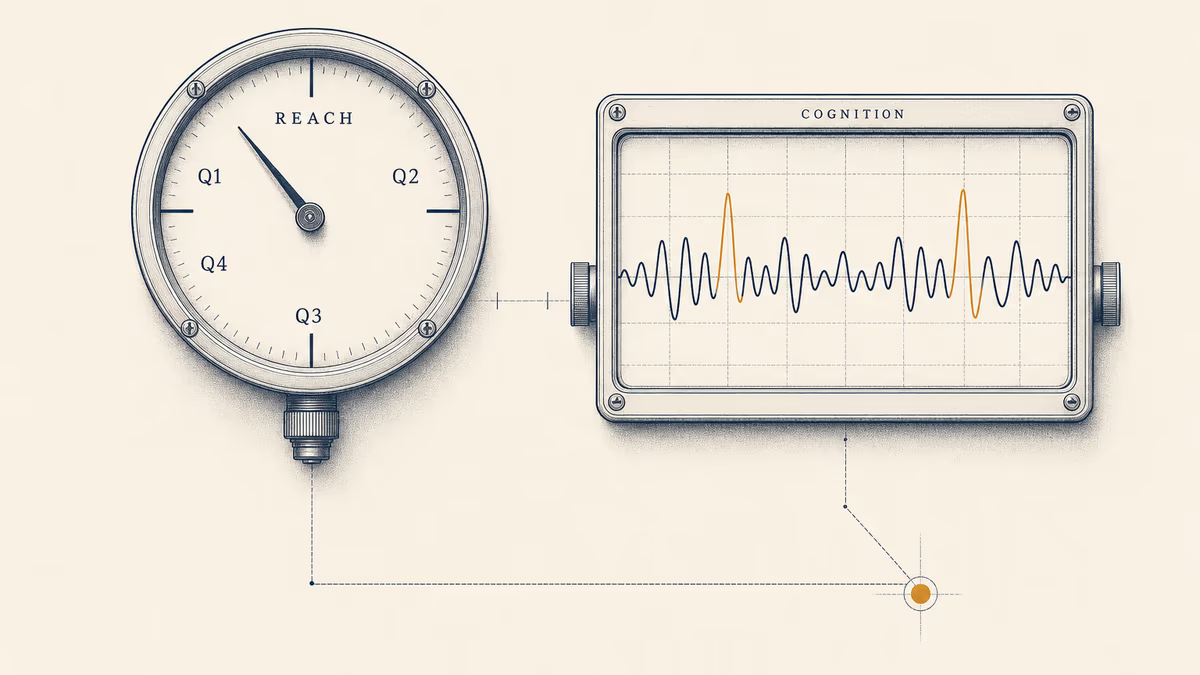
The recurring vocabulary the trade press has used to describe streaming for the last seven years — “the state of streaming” as shorthand for the quarterly volumes that quote hours, share, churn, and subscriber adds — is not the picture advertisers are pricing inventory against. Conviva’s State of Streaming report, the publication that put streaming-quality metrics on the trade map in 2018, was reframed last fall as the State of Digital Experience, anchored on delivery telemetry and agentic AI rather than streaming-specific reach. The Nielsen Gauge keeps publishing share-of-TV figures (47.5 percent to streaming in December, the highest on record). Antenna keeps publishing churn and net adds (3.2 million net SVOD additions in Q1). Comscore (NASDAQ: SCOR) publishes hours and households (13.9 billion streaming hours, up 6 percent). What none of them measure, by panel design, is whether anyone in the room was looking at the screen when the ad ran.
The cognition layer arrived in parallel, on a different calendar. The IAB and MRC finalized v1.0 of the Attention Measurement Guidelines in November, ratifying attention as a recognized measurement category. OpenX integrated TVision’s attention data pre-bid into the programmatic bidstream this spring. Viant (NASDAQ: DSP) agreed to buy TVision for $40 million on April 15, pulling cognition data inside the DSP. The next generation of “state of streaming” reports either grows a cognition layer or gets supplanted by the vendor reports that already have one. Buyers will keep the recurring volumes for context. They will price inventory off the cognition data, and the cognition data is on a separate publication cycle entirely.
What the recurring viewing reports actually measure
The reports are good at what they were built for. The mismatch is structural, not editorial. Walk the major recurring volumes across what they put on the page:
- Conviva’s State of Streaming report (now extending into the State of Digital Experience) measures quality of experience: rebuffering, video startup time, video start failures, picture fidelity by bitrate threshold, concurrent streams, plays, viewing time. Per Conviva’s benchmarking page, the spine is delivery telemetry. There is no attentive-seconds component, no cognitive-availability layer.
- The Nielsen Gauge measures share of total TV usage by category (broadcast, cable, streaming) and by distributor. December 2025 set the record at 47.5 percent to streaming. The Gauge’s methodology pause earlier this spring, which Peter Naylor described as “regret[ting]” the lack of impact data Nielsen provided in advance, was a controversy entirely contained inside the reach frame.
- Antenna’s State of Subscriptions measures gross adds, cancels, net adds, churn, retention. Transactional metrics for a subscription business.
- Comscore’s State of Streaming measures CTV households, streaming hours, FAST and AVOD growth, ad-tier penetration, services per household.
- Hub Entertainment Research measures ad-tier satisfaction, brand awareness, content discovery, value perception — all survey-based attitudinal data. Stated reception is not measured cognitive availability; the difference is the IAB/MRC framework’s whole point.
- Parks Associates × Philo’s “Unified Streaming” went further on advertising than the genre typically does: 51 percent of streaming subscribers interested in clicking ads, 49 percent interested in show-related shopping. It still anchored on stated interest, not eyes-on-screen.
Six recurring publications, six different reach-shape primitives. None carries a cognition or attention layer at the metric level. The panel structures aren’t built for it.

What the cognition vendors built in parallel
A separate stack was assembled while the quarterly cadence held. Adelaide Metrics launched the Attention Unit (AU) as an alt-currency framework, a 0–100 omnichannel score trained on outcomes, with benchmarks spanning roughly 20 to 70 AU across formats. TVision Insights built an in-home computer-vision panel measuring second-by-second, person-level eyes-on-screen across 24 billion seconds of TV viewing. Amplified Intelligence’s attentionTRACE, built on Karen Nelson-Field’s mental-availability research, established cross-screen attention thresholds: streaming TV captures roughly 9.7 active-attention seconds, about 8x mobile in like-for-like testing.
The verification incumbents followed. IAS Authentic Attention from Integral Ad Science (NASDAQ: IAS) probability-scores 50-plus exposure and engagement signals; IAS Total TV, launched last week with Disney, NBCUniversal, Paramount, and Prime Video as named partners, plugs into that infrastructure. DV Authentic Attention, DoubleVerify’s (NYSE: DV) attention layer, is MRC-accredited on desktop and mobile and combines DV’s exposure data with TVision’s viewer-presence signals on CTV. Seedtag’s neuro-contextual layer, validated through Columbia’s Moran Cerf, hardened into NeuroX, a neuro-contextual exchange, last month.
The cadence is the diagnostic. Adelaide ships methodology pages, platform integrations, and outcome guides as continuous releases. TVision, Amplified, IAS, DV, and Seedtag publish on rolling cycles tied to product shipments and partnership announcements. None of them publishes anything called “the state of streaming.” None of them is structured to. The cognition vendors are not in the recurring-viewing-report business; they are in the impression-pricing business, which runs on a different clock.
Where the gap shows up where money lives
The two streams collide in the upfront. The IAB and MRC’s November guidelines ratified four methodological approaches (data-signal-based measurement, visual and audio tracking, physiological and neurological observation, panel- and survey-based methods) and explicitly cautioned that “attention is not a standalone measure of ad effectiveness” and is “complementary data that works alongside delivery and outcome metrics.” That nuance matters. The framework didn’t replace reach. It put attention on the same shelf, with rigor.
What followed in the upfront cycle was a sequence of pricing moves. OpenX integrated TVision’s attention data into pre-bid auctions in March, with Erika Loberg, OpenX’s Global Head of CTV, calling it the moment advertisers can “activate attention as a targeting parameter at scale, in real time, and directly influence outcomes before the bid.” Viant’s TVision deal on April 15 deployed the same logic inside a DSP, with Tim Vanderhook framing it: “Every advertising platform measures its own performance today, which makes it difficult for advertisers to understand what’s actually working.” The deal positioned what Viant called “attention-adjusted CPM” as the buy-side direction of travel.
The vendor consensus has been forming for months. Brian Gleason, CEO of Seedtag, articulated the frame in his own voice on LinkedIn earlier this spring:
Beyond reach — think attention, intention, and emotional engagement as core performance metrics.
Scott Simonelli, the Veritonic founder and CEO whose company sits in audio measurement (not a CTV competitor), called the Viant–TVision deal “a real market signal” the day after it broke. “Measurement is no longer a recap slide at the end,” he wrote. “It is becoming core infrastructure.” Elizabeth Parks, the Parks Associates President and CMO who framed the recurring research on aggregation as strategic advantage, used vocabulary that exposes the gap rather than closes it: “consistent measurement and targeting capabilities.” Consistent reach measurement, with the cognition layer absent.
The publications still describe the same market. They describe it on different time bases, with different metric primitives, for different audiences. The reach reports tell a CFO and a programmer where the audiences went. The cognition stack tells a buyer what an impression is worth, before the bid.
What stays loose
The honest counterweight: cognition methodologies still vary across vendors. Adelaide’s AU is a model output. TVision is a panel. Amplified is eye-tracking and attention research. Seedtag is neuro-contextual EEG and fMRI. IAS and DV blend exposure data with engagement signals. The IAB/MRC framework codified that the four approaches are different methods, not interchangeable inputs to the same metric. Attention-adjusted CPM is announced; it is not yet transacting at scale across the major ad-supported sellers. The recurring viewing reports remain useful for audience-share context, broadcast-vs-cable-vs-streaming category questions, ad-tier-mix tracking, and quarterly subscriber math — work the cognition vendors don’t do.
The structural test runs through the rest of the upfront cycle and into Q2. The first read is the next release cycle of the recurring reports themselves. None of Conviva, Comscore, Antenna, Hub, or Parks Associates has announced an attention or cognition layer for their next volume; whether any of them does will say whether the panel structures can adapt or whether the gap stays where it is. The second read is the upfront pricing sheet. If 2026 materials from Disney, NBCUniversal, Paramount, WBD, Netflix, or Amazon surface attention-conditioned inventory with quoted CPM premiums, cognition has moved past the pilot-program register; if they don’t, it hasn’t. The third read is the Joint Industry Committee’s currency-certification rubric, built in 2023 to evaluate independent measurement vendors and not built to evaluate DSP-owned cognition data post-Viant–TVision close. The original holder of the State of Streaming brand has already moved on. The recurring volumes that inherited it have not.