
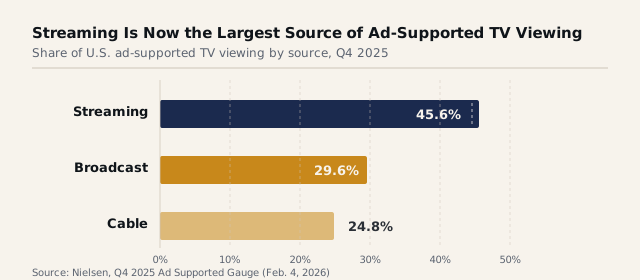
Ad-supported streaming is the new linear, on the math. Nielsen’s Q4 2025 Ad Supported Gauge, released February 4, put 74.2 percent of U.S. TV viewing on ad-supported platforms in the quarter, with streaming at 45.6 percent, broadcast at 29.6 percent, and cable at 24.8 percent. Streaming is no longer the upstart in the ad-supported pool. It is the largest source of ad-supported viewing the U.S. market produces, by a margin wider than the gap between broadcast and cable.
What hasn’t followed the dollars is the reporting infrastructure. Linear TV’s spec sheet — show-level, program-level, genre-level, rating-level placement signal — was the unit advertisers transacted on for 30 years. CTV scaled past linear’s share without inheriting that standard. Buyers transacting on premium streaming CTV could see device, geography, and viewability; show, genre, and rating moved through opaque publisher reporting if they moved at all, with the Video Privacy Protection Act of 1988 cited regularly as the legal hinge streamers used to keep placement data inside their walls. The vacuum is what the early-2026 product cycle is pricing against.
[Lisa Utzschneider, CEO of Integral Ad Science (IAS), the privately held ad-verification firm acquired by Novacap in December 2025](https://www.linkedin.com/posts/lisa-utzschneider-43345ba_streaming-has-rapidly-transformed-how-audiences-activity-7454512225437790208-M2b6), put the IAS frame on the gap this morning on LinkedIn, citing Nielsen’s numbers as the demand signal under IAS Total TV, the company’s CTV measurement suite that launched at the POSSIBLE conference in Miami Beach last week. “Streaming has rapidly transformed how audiences consume television,” she wrote. “According to Nielsen, 74.2% of all U.S. TV viewing is ad-supported, with streaming accounting for 45%. As streaming continues to grow at this scale, advertisers are increasingly seeking the same level of transparency they once relied on with traditional TV.” Total TV reports show, program, genre, rating, and language signals through the IAS Signal UI; the named partners are Disney, NBCUniversal, Paramount, Amazon’s Prime Video and Amazon MGM Studios, and opted-in publishers from Publica, IAS’s ad-server platform.
As streaming continues to grow at this scale, advertisers are increasingly seeking the same level of transparency they once relied on with traditional TV.
Utzschneider’s posting cadence on this topic is thin: two LinkedIn posts in the trailing 60 days, both product-launch announcements under her byline. It’s the cadence of a CEO who talks when her company ships. The voice that matters here is the one the market expects to hear from when the largest pure-play ad-verification vendor announces its largest CTV measurement product. She is well-positioned to know what buyers are asking for. She is also selling.
The four-month transparency-product flurry
The IAS launch is one move in a four-month sequence. DoubleVerify Holdings (NYSE: DV) shipped DV Authentic Streaming TV at CES in early January with a near-identical “linear-like” pitch and Mark Zagorski’s CEO framing that “the industry has been demanding better transparency and addressability in streaming TV.” DV cited its own research on the size of the gap: 15 percent of CTV programmatic transactions occurring outside premium streaming environments, more than $1 billion of misplaced spend per quarter, nearly 70 percent of marketers unable to justify CTV investment without better transparency. Six days before the IAS announcement, the IAB Tech Lab launched a Programmatic Governance Council with 13 founding members and zero direct advertisers, a seating chart MediaPost flagged as the structural gap. Three days after the IAS launch, IAB Europe opened a CTV Measurement Framework and Transparency Principles for public comment with the standards-body data on the gap: 30 percent of advertisers and publishers report full visibility into where CTV ads run, fewer than half use quality verification tools, 27 percent lack consistent insight into brand suitability.
Walked across a four-cell rubric, the moves cover overlapping ground with different reach:
- Show/program/genre signal: IAS Total TV publishes it from publisher metadata feeds. DV Authentic Streaming TV builds on its IMDb data licensing for program-level signal. IAB Europe codifies it as principle. PGC silent.
- Supply path: PGC’s Dynamic Traffic Engine is the on-the-ground attempt; the vendor products lean on supply-path signals as inputs rather than outputs.
- Brand suitability: all four cite it; only the vendor products execute it pre-bid.
- MRC accreditation: DV is the platform-by-platform accreditation incumbent — first on YouTube viewability in 2022, first on CTV in 2024, first on TikTok this April. IAS has not announced MRC accreditation for Total TV; on YouTube, IAS trailed DV by roughly 24 months on the same stamp.
The vendors say the same words and walk to the same buyer. The standards bodies put the same gap in the public record. The Trade Desk (NASDAQ: TTD) founder Jeff Green, on stage at POSSIBLE the same week, framed the broader pressure point without naming a verification product: “in the last month, we’ve done more to clean up the supply chain than we did in the last year.” The convergence is the datapoint. Four parallel responses to the same vacuum, in roughly four months.
Where Nielsen’s monoculture cracked
The unspoken backdrop is what changed about Nielsen in the same window. The 2024–2025 transition to Big Data + Panel was meant to keep Nielsen’s currency-grade product relevant against the streaming mix shift. The Gauge methodology controversy — postponements, sell-side criticism of the methodology change, and Nielsen’s own disclaimer, as informitv noted, that the Gauge figures do not reflect the ratings that inform advertising sales — corroded Nielsen’s neutral-arbiter posture in a way the trade press hasn’t fully metabolized.
What that opens, structurally, is a role Nielsen historically owned alone. Vendor-built transparency products are stepping in. Total TV is one. DV Authentic Streaming TV is another. Viant’s pull-TVision-inside-the-DSP move is a third. None is a currency replacement; all are reporting layers that price against the assumption that Nielsen alone can carry the burden of cross-publisher CTV measurement. The 74.2 percent / 45.6 percent Nielsen number is the launch ramp Utzschneider used. The Nielsen brand can’t carry the rest of the trip.
The publisher signal in the named-partner list
The most under-read element of the IAS launch is the partner list itself. Disney, NBCUniversal, Paramount, and Prime Video agreed to expose programming-level metadata to a third-party verifier — the same metadata streamers have spent five years citing the VPPA to keep inside their walls. AdExchanger reports IAS says Total TV is structured to comply with VPPA; that is IAS’s claim, not an independent legal review, and the legal posture has produced material streamer litigation. But the contractual willingness from four of the five largest U.S. ad-supported streaming sellers to feed show, genre, and rating data to a verification vendor is itself a signal that the publisher side has decided pre-bid transparency is now the price of carrying ad-tier supply at the scale Nielsen’s data describes. Netflix is the operator most absent from the list. It is also the operator that just disclosed more than 60 percent of new sign-ups on its ad tier and a base over 4,000 advertisers.
What follows from the convergence is a verification-incumbent land grab. The vendor that books the most exclusive publisher relationships, on the cleanest contractual terms, with the soonest path to MRC accreditation, sets the procurement default for the next upfront cycle. Two assumptions under that read are real and falsifiable: that the named partners do not signal with both DV and IAS simultaneously (the open question on Disney, NBCUniversal, Paramount), and that MRC accreditation continues to be the buyer-side credential that defines currency-adjacent procurement. If either breaks, the convergence is a vendor-pitch wave, not a category structural shift.
The IAB Europe public-comment window is the next standards-body checkpoint, with comments due in early summer. Whether the U.S. IAB Tech Lab proposes parallel CTV transparency principles is the cross-Atlantic test. MRC accreditation watch on Total TV and DV Authentic Streaming TV runs alongside, with DV’s pattern setting the timing benchmark. Q2 ad-tier disclosures from the named partners, particularly Disney’s first quarter without Disney+ and Hulu subscriber reporting, will tell buyers whether the publisher side is monetizing the transparency it just exposed. The piece still missing: a counter-launch from Roku or Samsung Ads, the smart-TV operators whose ACR data has been the alternative path into CTV reporting and who have so far stayed out of the verification-incumbent product lane.
The cleaner read of the four-month flurry is that the vendor category has decided ad-supported streaming is now linear’s procurement equivalent, and is racing to ship the reporting layer linear had 30 years ago. The slower read is that the publishers and standards bodies have decided the same thing, and the convergence is what the market does when an old monoculture stops carrying its load.