
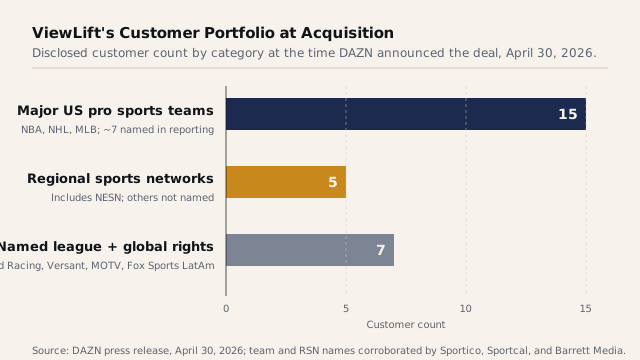
DAZN announced an agreement to acquire ViewLift, the white-label OTT vendor that powers 15 major US professional sports teams and five regional sports networks, in a transaction the company said will close subject to customary conditions. Sportico, exclusively reporting the price, put the deal at roughly $100 million in cash and equity with a June 2026 close target — figures DAZN did not disclose in its release.
The interesting line is what happened four months ago. In late December, the Wall Street Journal first reported that DAZN was in advanced talks to take a majority stake in Main Street Sports Group, the operator of FanDuel Sports Network and the post-bankruptcy successor to Sinclair’s Diamond Sports. The talks didn’t close. By January, Main Street’s nine MLB teams had terminated their contracts over missed payments; by April 3, Main Street confirmed it was winding down once the NBA regular season ended and the NHL playoffs cleared their first round. DAZN, The Desk reported the same day, was already approaching individual teams about interim streaming deals. ViewLift was on the same list.
So the structural read of the April 30 announcement is straightforward: DAZN couldn’t buy the RSNs, so it bought the layer underneath them.
The pivot that’s actually being announced
The DAZN US business has not, on any of its public efforts so far, become the destination. Boxing rights bought the early audience; the 10-year global NFL Game Pass deal outside the US and China bought scale ex-domestic; the August 2023 ATA Football acquisition added US women’s soccer; SURJ Sports Investment, the sporting arm of Saudi Arabia’s Public Investment Fund, took an estimated 10% DAZN stake for $1 billion in February 2025, partly to fund exactly the kind of US expansion the Main Street talks were supposed to deliver. Sportico has DAZN’s US subscription starting at $21 per month and the company employing roughly 150 people in New York. None of this has produced a DTC service of comparable household scale to ESPN’s, MLB’s, or Fubo’s.
ViewLift, founded in 2008, is the alternate-route product. It’s a B2B vendor — its white-label live page markets sub-three-second latency, 16-plus monetization models, and same-day deployment to web, iOS, Android, and smart-TV apps. It powers Altitude+ for the Colorado Avalanche and Denver Nuggets. Sportico and Sportcal name Vegas Golden Knights, the Florida Panthers, the Tampa Bay Lightning, Monumental Sports & Entertainment (the Capitals/Wizards/Mystics holding company), and the New England Sports Network as additional confirmed clients. Beyond US pro sports, ViewLift’s release lists the NHL itself, LIV Golf, the Professional Fighters League, World Racing Group, Versant, MOTV, and Fox Sports (Latin America). Counted as a portfolio, that’s the largest independent sports-OTT customer book in the US.
DAZN CEO Shay Segev framed the structural change in the company’s press release: the combination “will enable DAZN to extend its platform into a flexible B2B2C and SaaS model, supporting leagues and clubs that wish to maintain their own direct-to-consumer products while benefiting from DAZN’s global reach, infrastructure, and integrated ecosystem.” Translated: DAZN is not asking the team to put its game on the DAZN app; it’s offering to be the company that runs the team’s app. The financial logic is different. The customer is different. The competitive set is different.
Why federated, not consolidated
The conventional read of the post-Diamond settlement has been a consolidator thesis. After Sinclair’s Diamond Sports filed for Chapter 11 in 2023 and emerged two years later as Main Street, the working assumption inside the trade press was that the next stable equilibrium would be one or two large streaming destinations absorbing what the RSNs used to carry. Amazon’s failed $115 million Diamond investment in early 2024, DAZN’s failed Main Street bid in December, and now YouTube TV’s reported interest in a centralized 20-plus-team package all assume the same shape: rights holders aggregate to the platform that already has the household.
The DAZN-ViewLift configuration runs the opposite direction. It assumes the next phase of US sports streaming is many small team- and league-owned DTC apps that all happen to run on the same plumbing. The Main Street wind-down leaves 13 NBA teams and seven NHL teams without local distribution at the moment when team-DTC is, in some markets, already the de facto answer. ViewLift is what they spin up that DTC product on. We’ve covered the parallel pattern at the league level: the MLB 2026 schedule already lives across six platforms, and the team-DTC tier is the natural next layer of the same fragmentation.
This isn’t only DAZN’s view. The OTT-stack market itself just consolidated in this direction. Deltatre bought Endeavor Streaming in 2025, folding ViewLift’s largest infrastructure-layer competitor inside another sports/media holding company within twelve months. Two of the largest sports-specific white-label OTT vendors have now been acquired by larger sports/media platforms inside a single year. The destination layer is fragmenting; the infrastructure layer is consolidating.
The bet, and the things that break it
The ViewLift acquisition gives DAZN three things its destination-only US business never had. It gives DAZN inventory — 15 existing team contracts that produce predictable subscription revenue without DAZN having to acquire household reach to monetize. It gives DAZN a sales motion into every NBA, NHL, and MLB front office now staring at a wind-down date for their FanDuel Sports Network deal. And it gives DAZN a defensible position against the consolidator scenario: if YouTube TV does pull together a 20-team national local package, DAZN-ViewLift powers the apps for the teams that don’t sign.
The thesis breaks if YouTube TV moves quickly and at scale. A consolidator with Google’s distribution can foreclose ViewLift’s market by removing the DTC alternative; teams that can sign for a guaranteed minimum from a national package will not pay to run their own app. It also breaks if ViewLift’s 15 existing teams interpret the DAZN ownership as a competitive conflict, since DAZN is still operating its own DTC service in the same market the teams’ apps target, and the SaaS-vs-destination tension is real even when the press release waves it away. And it breaks if the unit economics of team-DTC don’t, in fact, work outside a handful of large markets like Colorado, Washington, Boston, and Las Vegas, and the 15 ViewLift teams turn out to be the natural ceiling rather than a floor.
The June close is the trigger. The first DAZN-ViewLift team announcement after that, particularly any of the late-April Main Street castoffs, is when the federated thesis gets its first market test. If it works, the next decade of US local sports streaming runs on shared rails, and DAZN owns them. If it doesn’t, the company still has the 15-team book it bought and another nine-figure bill for finally giving up on the destination it kept trying to build.