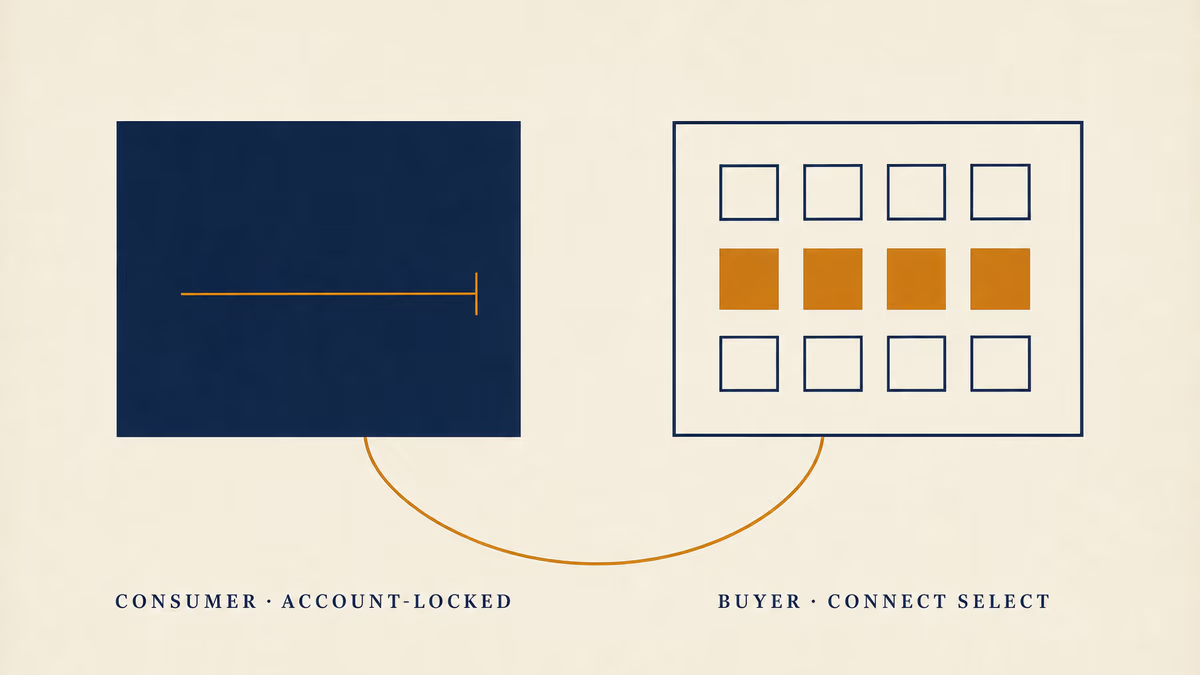
Walmart’s CTV stack just stopped being optional. As of March, newly purchased Vizio OS televisions and Walmart’s own onn-branded sets require a Walmart account at setup to unlock streaming, the app store, and the smart features the box was sold for. Five weeks later, the buyer-side capstone arrived. Walmart Connect launched Connect Select, a curated CTV marketplace embedded in Walmart DSP, with SSPs Magnite, PubMatic, FreeWheel, and Index Exchange and publishers Vizio, Paramount, and Warner Bros. Discovery.
The two moves are the same architecture viewed from two ends. Walmart now owns the operating system, the identity layer at the device, the demand-side platform, and a curated SSP shortlist. That is the canonical walled-garden template Amazon set with Fire TV, Prime Video, and Amazon DSP. The April 27 opinion piece we published argued that “independent” had stopped meaning anything buyers can audit on the buyer side. Five days later, the same erosion is visible at the device layer. The audit-surface argument is losing platforms one quarter at a time, and Walmart’s is the most aggressive yet.
Two moves, one identity gateway
Three reach figures are circulating, and they have to stay separate. Vizio’s last disclosure as a standalone company put SmartCast Active Accounts at 19.1 million at the end of Q3 2024. That is the rigorous number. The pitch number is bigger: Mike O’Donnell, Vizio’s chief revenue officer, told the NewFronts audience the platform sits “in the homes of 92 million people in the U.S.,” per StreamTV Insider — a household-population estimate, not an account count. The projection is bigger still: with Vizio’s OS migrating onto Walmart’s onn private-label sets (replacing Roku’s OS on those units, per AdExchanger), Walmart leadership has been telling buyers Vizio could reach 25 to 30 percent of U.S. households. Three numbers, three uses; pin all three.
Reach is not the structural argument. The 80 percent is. Walmart Connect’s Lara Barmish told the NewFronts audience that Walmart customers and Vizio users overlap roughly 80 percent, per StreamTV Insider, and the new account-required login is what converts that probabilistic overlap into a deterministic at-device match. Vizio’s Inscape ACR signal merges with the Walmart shopper graph not in a clean room, not via a third-party identity vendor, but at the television, bound to a Walmart account ID the buyer has already used to purchase products. That is a different identity primitive than anything an “open” CTV stack can produce.
What happens to the 2017 consent decree
This is the sharpest hook in the file, and nobody has publicly answered it. In February 2017, the FTC and the New Jersey Attorney General settled with Vizio for $2.2 million over the collection of viewing histories from 11 million smart TVs without consent. The order requires affirmative opt-in for ACR collection and biennial privacy assessments.
Walmart’s stated posture is that the new account-creation flow is “designed to respect consumer choice and privacy, with data used in aggregated, permissioned, and compliant ways,” per a Walmart spokesperson on-record to Android Authority. Existing Vizio account holders can merge or delete; new buyers create a Walmart account at TV setup. That is Walmart’s framing, and we cite it.
The unanswered question, the FTC included, is whether a Walmart-account creation step at TV setup is structurally equivalent to the affirmative-consent disclosure the 2017 order requires for Inscape ACR collection. The data-flow chain the settlement governed (Vizio Inscape feeding ad targeting) now connects to a Walmart-bound shopper graph the original order did not contemplate. Whether the existing decree governs the new posture, or needs to be revisited, is a structural privacy question that should be addressed before the architecture is fully deployed across 25 to 30 percent of U.S. households. We do not see a public answer.
Audit-surface erosion at the device layer
Magnite’s Premium+ Partner blog post frames Connect Select as “removing unnecessary intermediaries.” Magnite is not wrong about the performance benefits: fewer hops, faster bidding, better fill. The honest read of the same sentence from the buyer side is that intermediaries are also where audit happens. Third-party DSPs, third-party measurement vendors, third-party identity providers are the points at which a media buyer can independently verify what was bought, where it ran, and who saw it. Connect Select consolidates all of that inside Walmart’s DSP, on Walmart-owned supply, measured against Walmart’s first-party purchase data.
Ryan Mayward, Walmart Connect’s general manager, described the offering as “bringing together curated supply, Walmart’s first-party audiences, and seamless activation in Walmart DSP, so advertisers of all sizes can extend their brand building strategies into CTV.” Read it twice. Curated supply (Walmart-owned), first-party audiences (Walmart-owned), DSP (Walmart-owned), activation (Walmart-owned), measurement (Walmart-owned), at-device identity (Walmart-owned). The strongest case for the offering, and we will concede it now, is that mid-market and SMB advertisers historically gated out of CTV by minimums and supply complexity get a real on-ramp. AdExchanger’s Adam Bergman put the buy-side case plainly: “when you pair ad-supported video with home-screen activations, advertisers get big lifts in everything from awareness to purchase intent.” For an SMB whose alternative is no CTV at all, that lift is the point.
The concession is real. The argument is that the audit standard buyers apply to the gardens (what was the actual delivery, what was the incrementality, who measured it) should now apply to Walmart’s stack on identical terms. It currently does not. The buying community is treating Walmart Connect as a retail-media play rather than a walled-garden play, and that category mismatch is where audit goes to die.
Where Connect Select breaks from Roku Curate
The cleanest structural foil is Roku Curate, which launched the same day as Connect Select. Same retail-data convergence, same SSP-curation pitch, same SMB-friendly framing. Roku Curate stacks third-party retail data (Best Buy Ads, Criteo, Fandango, Fetch, Instacart, Kroger Precision Marketing) on top of voluntary user accounts. Connect Select aggregates Walmart’s own retail data on top of a TV that requires a Walmart account at setup to function as a smart TV. Same buyer-side pitch; opposite consumer-side posture. Walmart did not buy a smart-TV business in December 2024. It bought the third side of a retail-media triangle, and the past five weeks close it.
What buyers should actually do
The honest pitch from Walmart Connect should be: “We are a smaller walled garden competing with Amazon and Google, with a deterministic shopper-data overlay neither of them can match. Here is what is auditable about us, and here is what is not.” Buyers should ask three questions before treating Connect Select as a procurement category distinct from Amazon DSP. Is there an MRC-accredited measurement path on Vizio inventory post-Connect-Select that does not pass through Walmart’s own measurement stack? What is the operational difference between Magnite’s “Premium+” tier and the other named SSPs, and is it exclusive? Where exactly does the 2017 consent decree’s affirmative-consent requirement begin and end inside the new account-creation flow?
None have public answers right now. The May 6 Magnite earnings print is a partial test. So is whatever Walmart discloses at its next quarter — separate Vizio-attributed CTV revenue or another roll-up into Walmart U.S. consolidated advertising. The disclosure direction has been the opposite of Roku’s voluntary segment split, and the opposite of what an open-architecture pitch would produce. That is the read.